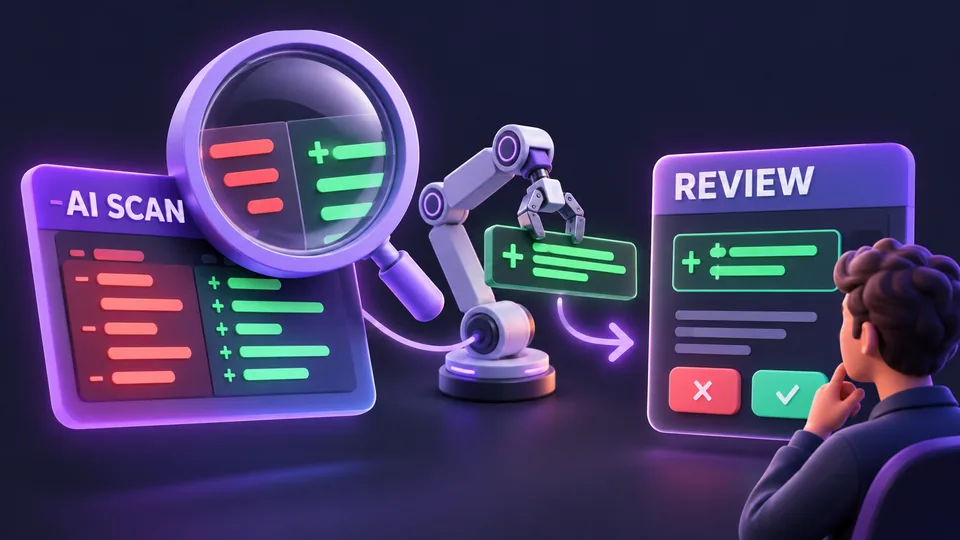
GitHub announced general availability for AI Scan on pull requests and agentic autofix for code scanning alerts on 15 October 2026. This report was checked on 17 October. The releases address two different moments: spotting a possible vulnerability in a proposed change, and preparing a repair for an existing alert.
For developers maintaining PHP applications or infrastructure code alongside other languages, the useful question is where the new signals appear and what they actually prove. An AI finding, a generated patch and a reviewed application change are separate steps.
AI Scan adds another signal during pull request review
According to the 15 October AI Scan announcement, the feature complements CodeQL in areas such as PHP, Shell/Bash, Terraform HCL and Dockerfiles. Findings appear in the pull request with an AI label, a risk explanation and, where available, a suggested change. They are advisory: they do not fail the code scanning check or enforce a merge block through rulesets.
That distinction matters when reading a green pull request status. A reviewer still needs to open the finding and assess the affected behavior. Teams should decide who owns those comments, rather than assuming that an existing required check will make the decision for them.
Check whether your repository is eligible
The AI Scan documentation describes public repositories owned by organizations or personal accounts as eligible. Private and internal organization repositories need GitHub Code Security or GitHub Advanced Security; personal private repositories are excluded. A Copilot license is not required, but usage is metered through Code Security AI Credits and subject to budgets.
Code scanning and the effective AI Scan setting must be enabled. Fork and Dependabot pull requests are excluded. Findings remain on pull requests rather than becoming backlog alerts, and full repository scans are not supported. GitHub also cautions that findings can be false positives. Administrators should check the billing account and inherited settings before enabling the feature across an organization.
Agentic autofix prepares a draft repair
In its separate 15 October agentic autofix release, GitHub describes assigning a default-branch code scanning alert to Copilot. The agent inspects relevant files, proposes changes, reruns CodeQL and can iterate before opening a draft pull request with an explanation and validation summary. Alerts found only on pull requests or other branches are outside that assignment workflow.
The release announcement covers GitHub Code Security and Advanced Security customers on Enterprise Cloud, including data residency. Agentic sessions consume Code Security AI Credits and Actions minutes. Consult the linked current documentation for repository eligibility and the applicable enterprise, organization and repository permissions before rollout.
Do not confuse a suggestion with a validated application
The autofix documentation distinguishes agentic autofix from Copilot Autofix, which offers a single suggested code change for the developer to apply. Agentic autofix is best effort. Its validation reruns the standard code scanning query suite; it cannot confirm fixes for custom CodeQL queries, the security-extended suite or third-party scanner alerts. GitHub explicitly calls for review and testing before merge.
These limitations also mean the two announcements should not be read as a promise that every AI Scan comment can flow directly into an agent-produced, verified repair. Their inputs and supported workflows differ.
Toolzify analysis: start with a small review exercise
The practical opportunity is to shorten the distance between a reported problem and a patch that someone can assess. Our recommendation is to begin with one eligible repository and a named reviewer. This is editorial analysis, not a measured performance result or a claim that Toolzify has enabled these features.
- Choose a bounded change. Pick a maintenance pull request whose behavior the team understands. Write down the expected behavior before looking at generated recommendations, so the review has an independent reference.
- Trace the reported path. Ask where the input comes from, which code consumes it and what outcome is possible. Record why the finding is relevant or why it is a false positive; merely counting comments gives little insight into their usefulness.
- Review the whole patch. Compare every changed file against the intended repair. Check whether error handling, permissions or a caller's expectations changed as a side effect. Request a smaller patch when unrelated edits make the repair difficult to assess.
- Keep application checks separate. Reproduce the original problem where feasible, then run the relevant regression tests. Read the agent's validation summary and identify which behavior your own checks still need to cover.
- Record cost and review effort. Track usage alongside accepted, rejected and revised proposals. Decide whether to expand only after the team can explain both the benefit and the work required to reach a merge decision.
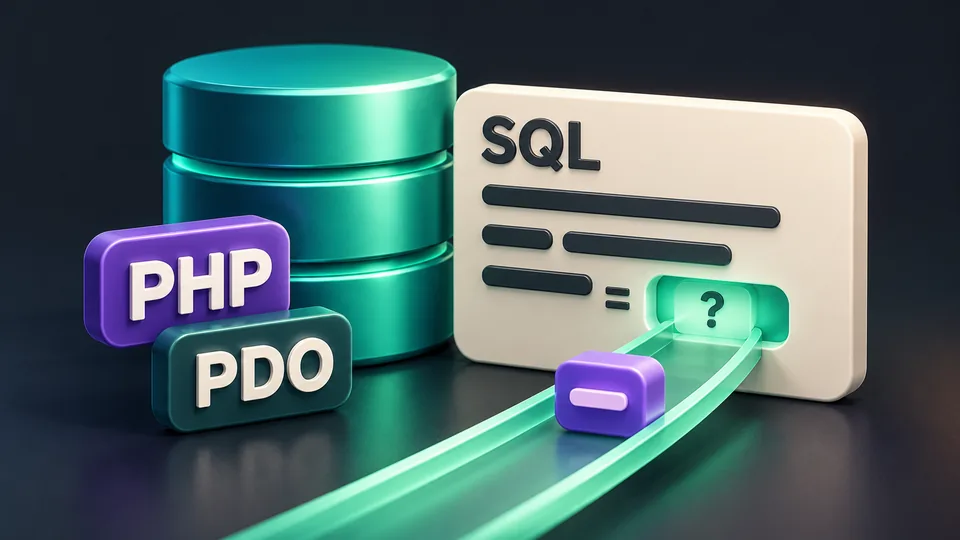
For a concrete PHP example of the input/query boundary a reviewer may need to inspect, see our runnable PDO prepared-statements tutorial. It demonstrates a specific query with quoted and SQL-looking values; it does not benchmark GitHub's scanners or establish how they classify that code.
This is a source-based news report with clearly labeled editorial analysis. No GitHub account settings were changed, agent session executed or detection-quality benchmark performed for this article.
Comments (0)
Join the discussion